
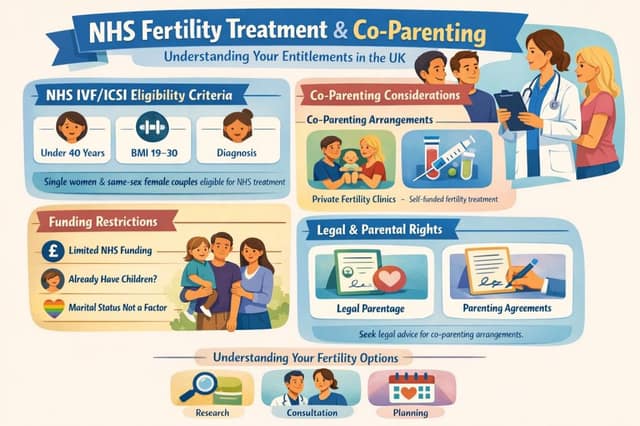
NHS IVF funding in England is decided locally, not nationally, so your access depends on where your GP is registered, your relationship status, and whether you already have children. Two people with identical medical needs can get completely different support simply because they live in different postcodes.
Getting NHS IVF and other fertility treatment in the UK mostly depends on your local Integrated Care Board, your personal situation, and whether you want to co-parent with someone, go solo, or are in a same-sex relationship. There is no single national rule for NHS IVF.
NHS IVF funding is not consistent across England, Scotland, Wales, and Northern Ireland. Local health authorities set the criteria, not one central body. Consequently, the NHS IVF support you receive can swing dramatically from one region to the next.
Ready to start your project?
Join +450,000 members who find their co-parent or sperm donor
Start free✓ Free ✓ No commitment ✓ Verified
Figuring out what the NHS actually covers for fertility treatment and co-parenting arrangements can feel overwhelming. The rules for NHS-funded IVF in England differ substantially from the rest of the UK.
Other factors count too — age, BMI, relationship status, and whether you already have kids. Same-sex couples and single women face their own criteria, and these change depending on where you are. This guide unpacks the realities of NHS fertility services, what treatments exist, how to handle regional differences, what legal protections co-parents get, and what to expect on waiting times and funding.
What Does the NHS Offer for Fertility Treatment and Co-Parenting?
The NHS provides fertility treatment through Integrated Care Boards, but where you live and your circumstances make a big difference to what you receive. Co-parents typically face extra requirements around artificial insemination cycles before NHS IVF is even considered.
Eligibility Criteria and Entitlements
Most Integrated Care Boards ask heterosexual couples to try two years of regular unprotected intercourse before they will fund NHS IVF. Female same-sex couples and co-parents using donor insemination usually need to self-fund six rounds of intrauterine insemination (IUI) first. Some areas raise that to 12 rounds before you can join the NHS IVF pathway.
Standard criteria across England typically include:
- Body Mass Index (BMI) between 19 and 30 for the person trying to conceive
- Non-smoking status for both partners
- Age restrictions that vary by region, but often fall between 23 and 42 years
Many ICBs will not fund IVF if either partner has living children, even adopted ones. However, some regions relax this and only require one person to be child-free.
Previous cycles matter too. Most ICBs refuse funding if either partner has already had more than two self-funded IVF cycles. Others won’t fund treatment after any previous NHS-funded cycle.
Regional Differences Across the UK
Access to NHS IVF really swings depending on your postcode. The North East and North Cumbria, for example, offers three full cycles for people up to age 40. Other places offer only one non-full cycle. Therefore, the same diagnosis can lead to very different NHS IVF outcomes.
A “full cycle” means one round of ovarian stimulation plus all the fresh and frozen embryo transfers from it. Non-full cycles usually cap frozen embryo transfers at one or two, no matter how many embryos remain.
| Region | Maximum Cycles | Age Range |
|---|---|---|
| North East and North Cumbria | 3 full cycles | Up to 40 |
| North East London | 3 full cycles | Up to 40 |
| Gloucestershire | 2 non-full cycles | 18-39 |
| Birmingham and Solihull | 1 non-full cycle | 20-40 |
Cryopreservation rules also vary. Some ICBs fund embryo storage for up to three years, while Cambridgeshire and Peterborough do not fund frozen storage at all. Always check the specific limit in your area.
The Role of Integrated Care Boards (ICBs)
Integrated Care Boards decide what gets funded based on local clinical need. They commission fertility services using National Institute for Health and Care Excellence (NICE) guidelines as a starting point, but they set their own additional rules on top.
Four ICBs are currently reviewing their policies: Cheshire and Merseyside, Greater Manchester, Humber and North Yorkshire, and Leicester, Leicestershire and Rutland. Residents there may still fall under older clinical commissioning group rules.
Because each board controls parental-status rules, previous-cycle limits, and storage duration, the NHS IVF that co-parents can access genuinely depends on their postcode. If you want funded treatment, request your ICB’s full Assisted Conception or Fertility Policy in writing.
Types of NHS IVF Treatments and Access Pathways
The NHS offers several fertility treatment options, including in vitro fertilisation, ICSI, and donor insemination. What is actually available depends heavily on your local Integrated Care Board, and co-parenting setups face extra hoops compared with traditional couples.
IVF and ICSI Treatments: Access and Criteria
In vitro fertilisation is the most common NHS-funded fertility treatment, but the number of funded NHS IVF cycles varies widely. Most ICBs now offer only one non-full cycle for women up to 40 — a far cry from the updated NICE guideline NG257, published in March 2026, which still frames eligibility around recognised clinical need.
ICSI (intracytoplasmic sperm injection) is usually available where there is male factor infertility, and it follows the same pathway as IVF. Both partners normally need to be non-smokers, and the woman conceiving must have a BMI between 19 and 30.
Parental status is decisive. Many areas refuse funding if either partner has children, even from a previous relationship or where they don’t have custody. Nevertheless, a handful of regions only consider children within the current relationship.
Donor Insemination and Sperm Donation
Donor insemination with donor sperm is an option for people who cannot conceive with their own gametes. This treatment must happen at a licensed clinic registered with the Human Fertilisation and Embryology Authority so that legal parentage is clear.
NHS funding for donor insemination changes by area. Some ICBs pay for a few cycles; others require private treatment first. Home insemination does not count towards NHS pathways and can create legal complications later.
Egg donation is less common but follows similar rules. At licensed clinics, the donor gains no legal parental rights or responsibilities. The HFEA keeps records, so donor-conceived children can access non-identifying information at 16 and identifying details at 18.
The NHS Process for Co-Parenting Arrangements
Co-parenting between friends or acquaintances who want to raise a child together hits significant barriers. Most ICBs treat these cases as “social infertility” rather than a medical need, so they don’t fund treatment — even when fertility problems exist.
If co-parents go private, a licensed clinic protects legal parentage. Using a sperm donor outside a clinic can leave the donor with parental rights, even with a private agreement in place.
Intended parents should establish legal parentage properly. Without a clinic, you risk disputes over custody, money, and decision-making. Licensed clinics require counselling so everyone understands the long-term stakes. Surrogacy is another route, but the NHS almost never funds it.
Fertility Treatments for Same-Sex Couples and Single Individuals
Female same-sex couples face extra requirements before getting NHS-funded fertility treatment. Most ICBs ask for six rounds of self-funded IUI first; some demand up to 12. This means lesbian couples often spend thousands privately before the NHS considers them eligible for NHS IVF — a stark contrast with heterosexual couples, who simply show two years of trying.
Single women face similar barriers and usually have to self-fund multiple IUI cycles. Male same-sex couples need surrogacy or a co-parenting arrangement with a woman willing to carry the pregnancy, and the NHS rarely funds surrogacy. Preimplantation genetic testing may be available where there is a specific genetic condition to screen for.
Regional Variations and Waiting Times for NHS IVF Services
Getting NHS IVF really comes down to where you live in England. NHS IVF waiting times can range from a few weeks to well over a year depending on the region, and each Integrated Care Board sets its own funding rules and eligibility.
The “Postcode Lottery” Explained
Each ICB writes its own commissioning policy, which is why variation is so wide. It isn’t just the number of cycles either — age limits, rules about existing children, and whether previous cycles count all change from place to place.
Some ICBs set the age limit at 35, others go up to 42. Parental-status rules shift too: some deny funding if either partner has any children, while others only look at children from the current relationship.
Current NHS Provision by Location
NHS IVF provision varies sharply across England’s ICBs. North East and North Cumbria and North East London offer three full cycles for people up to 40, the closest to NICE’s intended standard. Most regions offer far less NHS IVF.
Bath and North East Somerset, Swindon and Wiltshire give one non-full cycle for ages 25-40. Birmingham and Solihull fund one non-full cycle up to 40, but only for people with no children from any relationship. Buckinghamshire, Oxfordshire and Berkshire West, Frimley, plus Hampshire and Isle of Wight only fund treatment up to age 35.
Waiting Lists and Access Challenges
NHS IVF cycles funded across England have fallen significantly in recent years, and waiting times for pre-treatment investigations have lengthened. Because NHS IVF funding has shrunk, more people now explore self-funded options.
Long waiting lists and patchy provision mean couples sometimes wait months, even years, from referral to treatment. Geography and socioeconomic factors shape who can access care. Even in well-funded areas, waits can be long; in stricter regions, many self-fund or travel to private clinics.
Legal, Ethical and Regulatory Aspects of NHS Fertility and Co-Parenting
The Human Fertilisation and Embryology Authority oversees all fertility treatment in the UK, including donor conception and co-parenting setups. Legal parenthood, consent, and clinic licensing form the backbone of safe, ethical fertility care.
The Role of the Human Fertilisation and Embryology Authority
The Human Fertilisation and Embryology Authority (HFEA) regulates all fertility clinics and embryo research centres in the UK. It ensures clinics follow the Human Fertilisation and Embryology Act 1990 and the HFE Act 2008.
Every licensed clinic needs a valid HFEA licence, granted for up to four years, with inspections every two years against the Code of Practice. The HFEA also creates standardised consent forms that clinics must use, protecting everyone involved in donor conception and co-parenting.
Legal Considerations in Co-Parenting and Donor Arrangements
Legal parenthood depends on how conception happens. When people use donor insemination at a licensed clinic, the law spells out who the legal parent is. A sperm donor donating through a licensed clinic has no legal rights or responsibilities to any child born from their donation.
Intended parents must complete consent forms to establish legal parenthood. Where there’s a problem with HFEA consent paperwork, people can end up in parentage disputes with ex-partners, donors, or co-parents. With egg donation, the woman who carries and gives birth is always the legal mother.
Safeguards in Donor Conception and Licensed Fertility Clinics
Licensed clinics must follow strict rules when handling donor sperm and eggs. The HFEA requires donor screening, proper record-keeping, and informed consent from everyone involved. Records are kept for at least 30 years.
If a clinic falls short, the HFEA can add conditions to its licence, suspend it, or revoke it entirely. This oversight is exactly why people exploring co-parenting are advised to use a licensed route. Communities such as CoParents help connect prospective parents, donors, and co-parents before they take those formal clinical steps.
Frequently Asked Questions
What are the eligibility criteria for NHS IVF in the UK?
Eligibility for NHS IVF depends on your Integrated Care Board, which sets criteria around age, BMI, smoking status, previous cycles, and existing children. NICE recommends NHS IVF based on recognised clinical need, but local commissioners apply their own rules and some fund very little. Eligibility is based on your GP practice address, not your home address, so always request your ICB’s current Assisted Conception policy.
How does co-parenting affect entitlement to NHS fertility services?
Co-parenting arrangements usually face major barriers. Most areas only fund couples in established relationships, not co-parenting partnerships. Having existing children is a frequent disqualifier, even children from a previous relationship or who live elsewhere. NICE Quality Standard 73 states living children shouldn’t automatically block treatment, but local commissioners aren’t obliged to follow this and often set stricter rules.
What types of treatment does NHS IVF funding cover and how many cycles?
NHS IVF funding can cover fertility medicines, surgical procedures, and assisted conception such as IVF, ICSI, and intrauterine insemination. The number of funded cycles ranges from three full cycles in the most generous regions down to one non-full cycle — or none — elsewhere. Egg freezing is rarely funded unless medical treatment such as chemotherapy threatens fertility.
Are same-sex couples and single people eligible for NHS-funded treatment?
Same-sex couples face a postcode lottery in England. Many ICBs require six to 12 self-funded IUI cycles before considering NHS IVF, and some don’t fund same-sex couples at all. Anyone refused can appeal to their Integrated Care Board. England usually funds couples rather than single women, though Wales does fund single women, so check your local policy directly.
What legal steps should co-parents take before NHS fertility treatment?
The person who gives birth automatically becomes the legal mother. A married spouse or civil partner who consents usually becomes the second legal parent. Unmarried co-parents may need a parental responsibility agreement or court order. Using a licensed UK clinic means a sperm or egg donor gains no legal rights, whereas arrangements outside licensed clinics can leave donors with parental claims or maintenance obligations.
Thinking about co-parenting, donor conception, or simply exploring your options before approaching a clinic? You can create a free CoParents profile to connect with potential co-parents, sperm donors, and others on the same journey across the UK — at your own pace and on your own terms.