
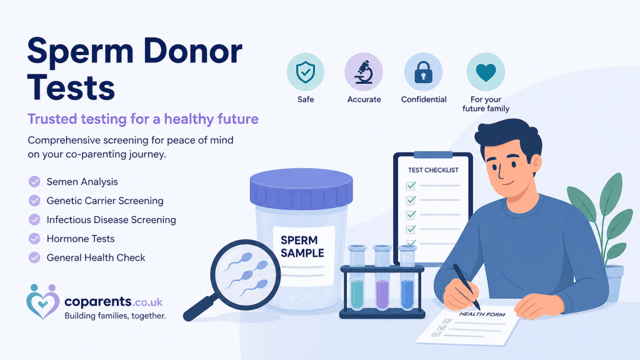
Sperm donor tests are a mandatory step before you can donate at any HFEA-licensed clinic in the UK.
Sperm donor tests cover everything from semen quality and infectious diseases to genetic screening and chromosome analysis. Before your sperm can be used in treatment, completing sperm donor tests means passing a structured series of medical checks that protect the recipient, any future child, and yourself. In 2026, these requirements are set out in the HFEA Code of Practice and apply to every licensed fertility clinic in England, Scotland, Wales, and Northern Ireland.
This guide explains exactly which tests are carried out, why each one matters, and what happens if results show a concern.
Who Is Eligible to Donate Sperm in the UK?
Before any sperm donor tests take place, clinics assess your basic eligibility. According to the HFEA’s guidance on donating sperm, donors should normally be over 18 and under 46. Some clinics set the upper limit at 41 to 44 to maintain sperm quality after freezing.
Ready to start your project?
Join +450,000 members who find their co-parent or sperm donor
Start free✓ Free ✓ No commitment ✓ Verified
You also need to:
- Have been a UK resident for at least 12 months (passport required)
- Be in good general physical and mental health
- Have a traceable family medical history covering parents, siblings, and grandparents
- Consent to your GP being contacted for your medical records
- Be free from any active sexually transmitted infection
Fewer than 5% of applicants pass all sperm donor tests and are ultimately accepted as donors, which reflects how rigorous the screening process is.
Why Are Sperm Donor Tests So Important?
The purpose of sperm donor tests is threefold. They protect the recipient from acquiring an infection. They protect any future child from being born with a hereditary condition or infection. And they protect you as the donor by ensuring you are in good health before you begin the donation process.
Donating through an HFEA-licensed clinic also provides clear legal protection. If you donate at a licensed clinic, you have no legal parental rights or financial responsibilities to any child conceived from your donation. If you donate outside a licensed clinic, the law treats you as the legal father — regardless of any private agreement.
The Full List of Sperm Donor Tests Required by HFEA Clinics
Here is a complete overview of the screening tests you will undergo at an approved UK fertility clinic.
1. Semen Analysis
This is the first of all sperm donor tests the clinic carries out. It assesses your sperm count, motility (movement), and morphology (shape). Clinics typically require a minimum of 15 million sperm per millilitre, with at least 40% motility and 4% normal morphology. Because not all sperm survive freezing and thawing, clinics demand higher-than-average parameters from donors.
2. Semen and Bacterial Culture
This test checks for bacterial contamination in the semen sample. Even without an active STI, bacterial presence can damage sperm quality and pose a risk to the recipient.
3. HIV I and II
All donors are tested for Human Immunodeficiency Virus. If you test positive, you cannot donate. Sperm at licensed clinics is frozen and quarantined for 180 days, and you are retested at the end of this period to rule out infections that may not appear on an initial screen.
4. Hepatitis B and Hepatitis C
Both are blood-borne viruses that can be transmitted through fertility treatment. Donors must test negative for hepatitis B surface antigen, hepatitis B core antibody, and hepatitis C antibody. Hepatitis B vaccination status is also recorded.
5. HTLV 1 and 2
Human T-Lymphotropic Virus has been linked to certain types of cancer and neurological conditions. British Fertility Society guidelines require all donors to screen negative for HTLV 1 and 2.
6. Chlamydia
Chlamydia is one of the most common sexually transmitted infections in the UK. Many people carry it without any symptoms. A positive result means you cannot donate until treatment is complete and you retest as clear.
7. Gonorrhoea
Like chlamydia, gonorrhoea can be present without obvious symptoms. It is tested via urine sample and swab. Active gonorrhoea disqualifies a donor until full clearance is confirmed.
8. Syphilis
A blood test screens for Treponema pallidum, the bacterium that causes syphilis. Early or latent syphilis may show no symptoms, making this test particularly important.
9. Trichomonas
Trichomonas vaginalis is a common parasitic infection. It is screened alongside the other STIs and must be absent before donation can proceed.
10. CMV (Cytomegalovirus) — IgG and IgM
CMV is a common virus that most adults carry without symptoms. However, it can cause serious complications for immunocompromised recipients or during pregnancy. Clinics record your CMV status and match donors with recipients accordingly.
11. Cystic Fibrosis Carrier Test
If you clear all infectious disease screening, you then undergo genetic testing. The cystic fibrosis carrier test checks whether you carry the CFTR gene mutation. 1 in 25 people in the UK is a carrier without knowing it. If both the donor and recipient are carriers, there is a 1 in 4 chance of a child being born with the condition.
12. Chromosome Analysis (Karyotype)
A karyotype test examines the structure and number of your chromosomes. Chromosomal abnormalities can lead to miscarriage, developmental issues, or inherited conditions. This test is a legal requirement under the HFEA’s Code of Practice.
Additional Genetic Screening Based on Ethnic Background
Depending on your ethnic origin, the clinic may also screen for:
- Sickle cell anaemia — more prevalent in donors of African, Caribbean, Middle Eastern, or Mediterranean heritage
- Tay-Sachs disease — particularly relevant for donors of Ashkenazi Jewish or French-Canadian background
- Thalassaemia — screened in donors of Mediterranean, Middle Eastern, South Asian, or Southeast Asian origin
Your blood group type is also recorded at this stage.
How Long Does the Donation Process Take?
The full process takes between 3 and 6 months from the first sperm donor tests to final clearance. You will usually visit the clinic once a week to produce samples. The 180-day quarantine period means your sperm cannot be used in treatment until a final retest confirms you are still clear of infectious diseases.
During this time, you are compensated up to £45 per clinic visit to cover reasonable expenses, in line with HFEA guidelines. Payment beyond expenses is illegal in the UK.
Can You Get Tested Privately Without a Clinic?
Arranging sperm donor tests privately is possible if you are considering private sperm donation rather than donating through a licensed clinic. Many sexual health clinics, GP practices, and private laboratories offer panels covering HIV, hepatitis B and C, syphilis, chlamydia, gonorrhoea, and semen analysis.
However, private testing does not provide the same legal protections as HFEA-licensed donation. Outside a licensed clinic, you may be treated as the legal father of any child conceived. The HFEA strongly advises donors and recipients to use licensed clinics wherever possible, even when the donor and recipient have arranged the match themselves through a platform like CoParents.co.uk.
What Happens If a Test Result Is Positive?
A positive result on sperm donor tests does not always mean the end of the road. For treatable infections such as chlamydia, gonorrhoea, or syphilis, you can retest after successful treatment. For incurable infections such as HIV or hepatitis C, donation at a licensed clinic is not possible.
For genetic carrier results, the clinic assesses the implications alongside the recipient’s own screening. Being a carrier for cystic fibrosis, for example, does not automatically disqualify you — it triggers a matched approach to ensure the recipient is not also a carrier.
Frequently Asked Questions
What blood tests are required for sperm donors in the UK?
Sperm donor tests include blood tests for HIV I and II, hepatitis B (surface antigen and core antibody), hepatitis C, syphilis, HTLV 1 and 2, and CMV (IgG and IgM). A full blood count and blood group typing are also carried out. Urine samples test for chlamydia, gonorrhoea, and trichomonas.
Do sperm donors need genetic testing?
Yes. All sperm donor tests carried out at HFEA-licensed clinics include a cystic fibrosis carrier test and a chromosome analysis (karyotype). Depending on ethnic background, donors may also be screened for sickle cell anaemia, Tay-Sachs disease, and thalassaemia.
How long does screening take before you can donate sperm?
The full process takes between 3 and 6 months. Initial sperm donor tests are completed in the first few weeks. Sperm is then frozen and quarantined for 180 days, and a final retest is required before any samples can be used in treatment.
Can I donate sperm if I have a sexually transmitted infection?
Not while the infection is active. For curable STIs such as chlamydia or gonorrhoea, you can complete treatment and retest. For incurable conditions such as HIV, donation at a licensed clinic in the UK is not permitted under current HFEA guidelines.
What is the difference between donating through a clinic and donating privately?
Donating through an HFEA-licensed clinic means you have no legal parental rights or financial obligations to any child born. Private donation outside a licensed clinic can result in you being treated as the legal father under UK law. Our guide on sperm donation in the UK covers your rights in full.
Whether you have completed your sperm donor tests or are still exploring your options, CoParents.co.uk is the UK’s leading platform to connect sperm donors with single women, same-sex couples, and co-parenting families across the UK and Ireland. Join over 450,000 members and start your journey today.