
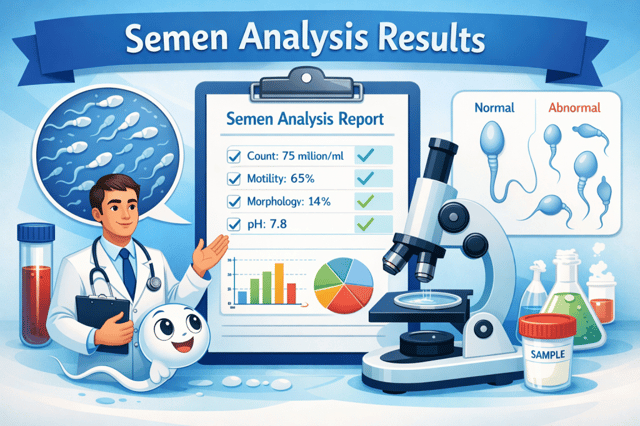
Your semen analysis results hold the key to understanding your fertility. A semen analysis — sometimes called a sperm test — is the single most important diagnostic tool for assessing male reproductive health. It measures critical indicators including sperm count, motility, morphology, and semen volume based on reference values set by the World Health Organization (WHO) in its 6th edition laboratory manual, published in 2021. Around 1 in 7 couples in the UK experience difficulty conceiving, and in approximately 40% of those cases, male fertility factors play a significant role. Understanding your semen analysis results is the essential first step toward finding the right solution.
What Are Semen Analysis Results and Why Do They Matter?
Semen analysis results provide a detailed snapshot of the health, quantity, and quality of the sperm your body produces. If you have been trying to conceive for 12 months without success — or 6 months if your partner is over 36 — your GP or fertility specialist will likely recommend a semen analysis as one of the first investigations. The test is quick, painless, and provides valuable data that can identify whether a male factor is contributing to difficulty conceiving.
According to research published in Andrology (2024), the WHO’s 6th edition manual has made semen analysis more robust by incorporating data from 3,589 fertile men across multiple geographical regions, resulting in more reliable reference values than previous editions. Your semen analysis results are evaluated against these WHO benchmarks to determine whether further investigation or treatment is needed.
Ready to start your project?
Join +450,000 members who find their co-parent or sperm donor
Start free✓ Free ✓ No commitment ✓ Verified
On platforms like CoParents.co.uk, a co-parenting and sperm donation network with over 150,000 users since 2008, understanding your fertility health is an important step whether you are trying to conceive with a partner, considering co-parenting, or thinking about becoming a sperm donor.
What Does Semen Volume Tell You?
Semen is far more than just sperm. In fact, sperm cells make up only about 5% of the total ejaculate. The remaining fluid is produced by the seminal vesicles and prostate gland. This fluid plays a vital role in stabilising, nourishing, and protecting sperm as they travel through the female reproductive tract.
According to the WHO, a normal semen volume is 1.4 millilitres or more — roughly half a teaspoon. A volume below this threshold may indicate a blockage in the reproductive tract, a hormonal imbalance, or retrograde ejaculation (where semen flows back into the bladder instead of exiting the body). Low volume can also be linked to stress, dehydration, or an unusually short abstinence period before the test.
How Do You Interpret Sperm Count in Your Semen Analysis Results?
Total sperm count is one of the most straightforward values in your semen analysis results. It measures the total number of sperm cells in the entire ejaculate. The WHO defines a normal total sperm count as 39 million or more. A count below this level is classified as oligozoospermia and may indicate problems with sperm production, a hormonal imbalance, or a physical blockage.
Sperm concentration — a closely related measurement — looks at how many sperm are contained in each millilitre of semen. A normal concentration is 16 million sperm per millilitre or more. If your sperm count falls below these thresholds, lifestyle factors such as diet, smoking, alcohol consumption, and excessive heat exposure are often investigated first. Medical causes including varicocele, infections, and hormonal disorders may also be responsible.
What Does Motility Mean in a Sperm Test?
Motility measures the percentage of sperm that are moving and how well they move. For natural conception, sperm must swim effectively through the cervix, uterus, and fallopian tubes to reach the egg. Your semen analysis results will show two key motility figures: total motility (any movement at all) and progressive motility (forward movement in a straight line or large circles).
The WHO recommends that at least 42% of sperm should be motile, with a minimum of 30% showing progressive movement. Low motility — known as asthenozoospermia — can be caused by smoking, certain medications, varicocele, excessive alcohol intake, or prolonged exposure to heat. If your motility is below normal, your doctor may recommend lifestyle changes or refer you for further testing to identify the underlying cause.
How Important Is Sperm Morphology?
Morphology assesses the shape and structure of individual sperm cells. Only correctly shaped sperm can penetrate and fertilise an egg successfully. A healthy sperm cell has an oval-shaped head approximately 5 micrometres long and 3 micrometres wide, a well-defined midpiece, and a long, straight tail. Abnormalities in any of these areas — such as a misshapen head, a bent tail, or a double tail — reduce the sperm’s ability to reach and enter the egg.
The WHO considers a sample normal if at least 4% of sperm have a standard shape. This may sound low, but it is based on strict assessment criteria. A morphology result below 4% is called teratozoospermia and may indicate illness, testicular problems, or overexposure to high temperatures. Your semen analysis results for morphology should always be interpreted alongside other parameters, as morphology alone rarely determines fertility outcomes.
What Do Viability and Liquefaction Mean in Your Results?
Viability (sometimes called vitality) measures the percentage of live sperm in a sample. This is particularly important for men with low motility, as it helps distinguish between sperm that are alive but not moving and sperm that are dead. According to WHO guidelines, at least 54% of sperm should be viable. Certain lubricants can harm sperm viability, so always use a fertility-safe brand when trying to conceive.
Liquefaction refers to the process by which semen changes from thick and sticky (which helps it adhere to the cervix after ejaculation) to more liquid (which allows sperm to swim freely). This normally takes between 15 and 30 minutes. Delayed or incomplete liquefaction can trap sperm and prevent them from reaching the egg. It may indicate a problem with the prostate gland or seminal vesicles. Your semen analysis results will note whether liquefaction occurred within the normal timeframe.
What Should Semen pH Be?
The pH level of semen indicates how acidic or alkaline it is. Sperm thrive in a slightly alkaline environment. The WHO sets a normal semen pH at 7.2 or above. Semen that is too acidic can damage or kill sperm, significantly reducing fertility. Abnormal pH levels are often accompanied by other irregular semen analysis results and may point to a blockage, an infection, or a problem with the accessory glands.
If your pH is below 7.2, your doctor may order additional tests to investigate the cause. A low pH combined with low volume and the absence of fructose in the semen can suggest ejaculatory duct obstruction. These findings together help your specialist build a clearer picture of your reproductive health.
How Should You Prepare for a Semen Analysis?
Preparation is straightforward but important for getting accurate semen analysis results. Your doctor will ask you to abstain from sexual activity for 2 to 7 days before providing the sample — most clinics recommend 3 to 4 days as optimal. Longer abstinence can affect motility and morphology, while shorter periods may reduce volume and count.
You will normally be asked to provide the sample through masturbation, either in a private room at the clinic or at home using a sterile container provided by the laboratory. If collecting at home, the sample must reach the lab within 60 minutes and should be kept at body temperature during transport. According to the University College London Hospitals NHS Trust, the entire ejaculate should be collected, as the first fraction typically contains the highest sperm concentration.
Your doctor may also ask you to avoid alcohol, caffeine, and recreational drugs in the days before the test, and to disclose any medications or supplements you are taking. Because semen quality can fluctuate, most specialists recommend at least two analyses taken several weeks apart before drawing firm conclusions.
What Should You Do If Your Semen Analysis Results Are Abnormal?
Abnormal semen analysis results do not necessarily mean you cannot conceive. Many causes of poor sperm quality are treatable or improvable. Your doctor will assess your results in context — taking into account your overall health, lifestyle, medical history, and your partner’s fertility status.
For many men, lifestyle changes can significantly improve sperm health within 2 to 3 months (the time it takes for new sperm to develop). These changes include reducing alcohol intake, stopping smoking, improving diet with antioxidant-rich foods, maintaining a healthy weight, and avoiding excessive heat from hot baths, laptops on the lap, or tight underwear.
If lifestyle changes are not enough, medical treatments may include hormone therapy, surgery to correct a varicocele, or assisted reproductive techniques such as IUI or IVF with ICSI. ICSI (intracytoplasmic sperm injection) is particularly effective for men with very low sperm count or poor motility, as only a single healthy sperm is needed to fertilise the egg.
Frequently Asked Questions
What are normal semen analysis results according to WHO guidelines?
The WHO 6th edition (2021) defines normal semen analysis results as: volume of 1.4 ml or more, total sperm count of 39 million or more, concentration of 16 million per ml or more, total motility of 42% or more, progressive motility of 30% or more, morphology of 4% or more normal forms, viability of 54% or more, and pH of 7.2 or above. Results below these thresholds warrant further investigation.
How long do semen analysis results take?
Most laboratories provide semen analysis results within 5 to 10 working days. Some private clinics offer same-day or next-day results. Your results will be sent to the doctor who referred you for the test.
Can semen analysis results change over time?
Yes. Sperm quality fluctuates due to illness, stress, medication, lifestyle habits, and seasonal factors. This is why specialists typically recommend at least two analyses before making clinical decisions. Positive lifestyle changes can improve semen analysis results within 2 to 3 months.
Should I get a semen analysis before becoming a sperm donor?
Yes. All HFEA-licensed clinics require a semen analysis as part of the donor screening process. Clinics typically demand higher-than-average sperm parameters because not all sperm survives the freezing and thawing process. Understanding your semen analysis results before applying saves time and helps you decide whether clinic-based or private donation is the right path for you.