
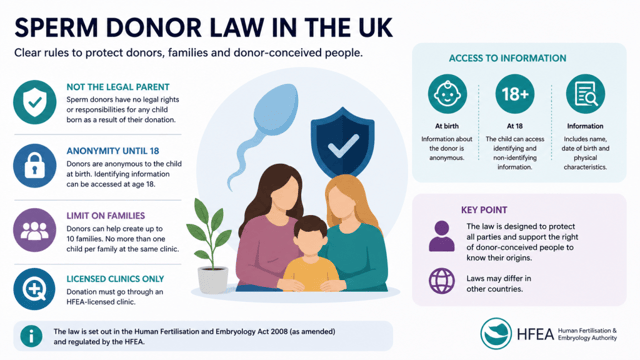
Sperm donor law in the UK governs everything from anonymity and parental rights to the legal consequences of donating outside a licensed clinic. Whether you are considering becoming a donor, looking for a donor, or navigating a known donor arrangement, understanding sperm donor law before you begin is essential — the difference between a clinic-based donation and a private arrangement can have far-reaching legal consequences for everyone involved, including the child.
What Is the Primary Legislation Governing Sperm Donor Law in the UK?
The foundation of sperm donor law in the UK is the Human Fertilisation and Embryology Act 2008 (HFE Act), which updated and replaced the original 1990 Act. This legislation defines legal parenthood in the context of donor conception, sets the rules on anonymity, governs the rights and responsibilities of donors and recipients, and establishes the regulatory framework administered by the Human Fertilisation and Embryology Authority (HFEA).
The HFE Act covers three core areas that every donor and recipient must understand: parental status, anonymity, and consent. Each of these works differently depending on whether conception takes place at a licensed clinic or through a private arrangement — and sperm donor law treats these two routes very differently.
Ready to start your project?
Join +450,000 members who find their co-parent or sperm donor
Start free✓ Free ✓ No commitment ✓ Verified
Sperm Donor Law on Anonymity
Under sperm donor law as it stands in 2026, anonymous donation through a licensed clinic has been prohibited since 1 April 2005. Every donor who donates at an HFEA-licensed clinic after that date must accept that a donor-conceived person can request identifying information once they turn 18. That information includes the donor’s full name, date of birth, and last known address.
Before age 18, from age 16, the donor-conceived person can request non-identifying information: the donor’s physical description, ethnicity, year and country of birth, medical history, and any goodwill message written at the time of donation.
Donors who donated before April 2005 were promised anonymity at the time. However, the law now allows those donors to voluntarily re-register as identifiable if they wish to be contactable. It is also worth noting that home DNA testing has fundamentally altered the practical reality of anonymity: a 2020 survey found that 78% of donor-conceived respondents successfully identified their donor using consumer DNA testing services — regardless of the legal framework.
As an anonymous donor, you have no legal right to contact offspring conceived from your donation. Any contact must be initiated by the donor-conceived person, not the donor. For a full breakdown of what information can be shared and when, see our guide to anonymous sperm donor rules in the UK.

Sperm Donor Law: Clinic vs Private Arrangement
The single most important distinction in sperm donor law is whether conception takes place at an HFEA-licensed clinic or through a private arrangement. The legal consequences of each route are dramatically different.
Donating through a licensed clinic
When you donate through an HFEA-licensed clinic, sperm donor law is clear: you are not the legal father of any child conceived from your donation. According to the HFEA’s guidance on sperm donation and the law for donors, this means you will not be named on the birth certificate, you have no parental rights, and you have no financial responsibility for the child. This protection applies regardless of whether the recipient is a single woman, a heterosexual couple, or a same-sex couple — and regardless of whether you are an anonymous or identifiable donor.
A single donor can help create a maximum of 10 families under UK law. Compensation is capped at £45 per clinic visit to cover expenses — paying for sperm itself is illegal.
Donating privately outside a clinic
Private arrangements — where you donate directly to a recipient without going through a licensed clinic — operate under entirely different rules. Under current sperm donor law, if conception occurs through a private arrangement, the legal position depends on the recipient’s circumstances:
- Heterosexual married couples: If the husband consents to artificial insemination, he is the legal father and you have no parental status. However, if the husband does not consent, or if conception occurs by natural means (sexual intercourse), you may be deemed the legal father.
- Lesbian couples in a civil partnership or marriage: If both partners consent and the civil partner agrees to the insemination, she is the second legal parent. If the couple is not married or civil partnered and conception occurs at home, you may be treated as the legal father.
- Single women and unmarried women: If conception takes place outside a licensed clinic, you will generally be the child’s legal father — with full parental rights and financial responsibilities.
Crucially, no private written agreement can override this. Even if the mother has explicitly agreed in writing that you will not be the legal father, that agreement has no legal force. The HFEA is unambiguous on this point: you cannot opt out of being the legal father of a privately conceived child, even if the mother consents.
This is why understanding sperm donor law before any private arrangement is not optional — it is essential. For more detail on how private donations work legally, see our guide to donor parental rights in the UK.
Sperm Donor Law and Natural Insemination
If you are asked to inseminate naturally — that is, through sexual intercourse rather than artificial insemination — sperm donor law classifies you as the biological father, with full parental responsibility and potential liability for child maintenance. No agreement to the contrary protects you. If you are approached to inseminate by natural means and wish to avoid legal parenthood, the only safe route is to decline and use a licensed clinic for artificial insemination instead.
Donor Agreements: What They Can and Cannot Do
In known donor situations, many parties draw up a written agreement setting out the donor’s intended role — whether they will be involved in the child’s life, what custody or contact arrangements are anticipated, and how parenting decisions will be made.
Under UK law, these agreements are not legally binding. A court is not obliged to follow them, and a family court will always decide any dispute based on the child’s best interests — not on what the adults agreed before conception. However, a well-drafted donor agreement is still strongly recommended because it records everyone’s intentions at the time of donation, it can carry evidential weight in court proceedings, and it helps prevent misunderstandings before they escalate into disputes.
Always instruct a family law solicitor when drafting a donor agreement. Do not rely on templates downloaded from the internet. For more on the considerations involved, see our guide to things to consider before sperm donation.
Sperm Donor Law: Key Rules at a Glance
| Scenario | Donor’s legal status | Donor’s financial responsibility |
|---|---|---|
| Licensed clinic — any recipient | Not the legal father | None |
| Private — married heterosexual couple (husband consents) | Not the legal father | None |
| Private — civil-partnered or married lesbian couple (partner consents) | Not the legal father | None |
| Private — single woman or unmarried recipient | Legal father | Liable for child maintenance |
| Natural insemination (any recipient) | Legal father | Liable for child maintenance |
Frequently Asked Questions About Sperm Donor Law in the UK
Can a sperm donor be forced to pay child maintenance under UK sperm donor law?
Yes, if the donation takes place outside a licensed clinic and the donor is subsequently treated as the legal father. The Child Maintenance Service does not distinguish between biological fathers and donors — if you are legally the father, you can be pursued for maintenance regardless of any private agreement to the contrary. Donating through an HFEA-licensed clinic is the only reliable way to avoid this risk.
Does sperm donor law give a donor any rights over the child?
When donated through a licensed clinic, no. The donor has no parental rights, no right to contact the child, and no say in how the child is raised. Under sperm donor law, the donor-conceived person has the right to request identifying information at 18 — but that is the child’s right, not the donor’s. If you donate privately and are treated as the legal father, you acquire both rights and responsibilities, which may include the right to apply for a child arrangements order. See our guide to donor conception, surrogacy and co-parenting laws in the UK for a broader overview.
What is the 10-family limit in sperm donor law?
Under UK sperm donor law, each donor can help create a maximum of 10 families through licensed clinic donations. This limit is set by the HFEA and is designed to reduce the risk of donor-conceived half-siblings unknowingly forming relationships. There is no equivalent limit for private donations.
Can a sperm donor remain anonymous if they donate before the child turns 18?
For donations made after 1 April 2005, the answer under sperm donor law is no — not in the long term. While donors are not identified to recipients or the child during the child’s minority, identifying information will be released to the donor-conceived person on request once they turn 18. Additionally, home DNA testing has made practical anonymity increasingly unreliable, regardless of the legal framework. For donations made before 2005, the donor remains legally anonymous unless they choose to re-register as identifiable.
What should I do if I want to become a known donor to a specific person?
The safest route under UK sperm donor law is to arrange for insemination to take place at an HFEA-licensed clinic, even if you are a known donor. This protects you from being classified as the legal father and ensures that the correct legal parenthood consent forms are completed. Draft a donor agreement with a family law solicitor before proceeding, and discuss the level of involvement you expect to have — or not have — in the child’s life.
You can find potential matches and learn more about how known donor arrangements work on CoParents.co.uk, where donors and recipients connect directly and discuss expectations openly. For more on how to navigate the process, see our guide on how to donate sperm in the UK.
Understanding sperm donor law before you begin protects everyone involved — the donor, the recipient, and above all the child. If you are ready to explore your options, CoParents.co.uk connects donors and prospective parents across the UK in a transparent, supportive environment.
Register on CoParents.co.uk today and start a conversation with people who share your values and are navigating the same questions you are.