
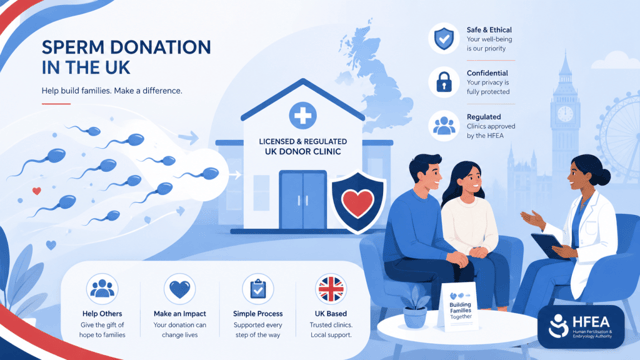
Sperm donation in the UK is one of the most meaningful things a man can do to help individuals and couples who cannot conceive on their own. For recipients — whether they are heterosexual couples dealing with male infertility, lesbian couples, or single women — a donor’s contribution can be the difference between having a family and not. However, sperm donation is not a decision to make on impulse. There are legal rules, medical requirements, and long-term personal implications that every potential donor must understand before proceeding.
Why the UK Needs More Sperm Donors
The UK has a persistent shortage of donor sperm, particularly from donors representing ethnic minority communities. This matters because recipients often want a donor who shares their background, and shortfalls in diversity mean some people face longer waiting times or are forced to import sperm from overseas banks.
Internationally, Cryos International in Denmark operates the world’s largest sperm bank and ships donations to clinics and individuals across the globe. In the UK, licensed sperm banks such as the London Sperm Bank and Birmingham Spermbank serve the domestic market and are regulated by the Human Fertilisation and Embryology Authority (HFEA).
Ready to start your project?
Join +450,000 members who find their co-parent or sperm donor
Start free✓ Free ✓ No commitment ✓ Verified
Religious and cultural attitudes remain a barrier for some communities. In certain traditions, sperm donation stigma persists because the act is seen as incompatible with beliefs about procreation or fidelity. Greater awareness and open conversation can help shift these perceptions — because for the families who need a donor, the impact is profound.
Why You Must Use a Licensed Clinic for Sperm Donation
This is the single most important rule in UK sperm donation: always donate through an HFEA-licensed clinic. Here is why it matters so much.
If you donate through a licensed clinic, you have no legal parental rights or financial responsibilities towards any child born from your donation. You will not appear on the birth certificate. You will have no say in how the child is raised and no obligation to contribute financially. The HFEA confirms that donating at a licensed clinic gives you full legal protection as a donor.
However, if you donate outside of a licensed clinic — through a private arrangement, a social media group, or a website — the legal position is far more complex. In that scenario, you could be treated as the child’s legal father, with all the parental and financial responsibilities that entails. That is not a position most donors intend to be in, and it cannot always be resolved by a private agreement, no matter what the recipient says at the time.
The HFEA regulates clinics to ensure all donors are properly screened and counselled, and that every aspect of the process complies with UK law. For a full breakdown of how the process works, read our guide on the sperm bank process in the UK.
Who Can Donate Sperm in the UK?
To donate at an HFEA-licensed clinic, you must generally meet the following criteria:
- Age: between 18 and 46 (clinics may accept slightly older donors in rare circumstances)
- Health: medically fit, free from sexually transmitted infections, HIV, and Hepatitis B and C
- Family history: no serious inherited disorders in your immediate family
- Sperm quality: sufficient count, motility, and morphology to survive freezing
- Lifestyle: no recreational drug use; willingness to abstain for a few days before each donation
- No prior donations: UK law prevents clinics from accepting donors who have already donated elsewhere, as each donor is limited to helping create a maximum of 10 families
The sperm donation process takes three to six months and typically involves weekly visits to provide samples. Each donation is frozen, quarantined for up to six months, and retested before it can be released for use. Donors can claim up to £45 per clinic visit to cover expenses — paying beyond this is illegal in the UK.
For full eligibility details, see our article on how to become a sperm donor in the UK.
The End of Anonymity: What the 2005 Law Change Means for Sperm Donation
Before April 2005, sperm donation in the UK was anonymous. Many donors — students and others — donated in the knowledge that their identity would never be disclosed. That protection no longer exists.
Since 1 April 2005, anyone born from a donation made on or after that date has the legal right, once they turn 18, to request their donor’s identifying information from the HFEA. This includes the donor’s full name, date of birth, and last known address.
The HFEA’s guidance on sperm donation and the law for donors makes clear that no donor can opt out of this. A donor-conceived person has the right to that information regardless of any private agreement made at the time of donation.
Additionally, the rise of consumer DNA testing services means that donors may be identifiable even earlier and outside of the HFEA system. If a donor-conceived person — or one of their close genetic relatives — uses a home ancestry kit and opts into matching services, the donor could be identified without any formal request being made.
The HFEA also holds records going back to August 1991. A donor-conceived person researching their origins will be able to see basic information including date and place of birth, which significantly narrows identification online. If the donor has had children of their own, the donor-conceived person may discover they have half-siblings.
The Emotional Side of Sperm Donation
Sperm donation is a generous and selfless act, but it carries real long-term emotional weight. Before you donate, ask yourself whether you are genuinely comfortable with the following possibilities:
- A donor-conceived person contacting you at age 18, wanting to meet or simply know more about you
- Your own children or partner finding out about your donation — now or years later
- The existence of up to 10 families, and potentially many children, who share your genetics
Licensed clinics are required by law to offer all donors counselling before the sperm donation process begins. This is not optional red tape — it is a genuine opportunity to work through these questions with a professional before you commit. Take it seriously.
The most practical advice is to be open from the start. Tell your partner and, if relevant, your children about your decision to donate. If a donor-conceived person does reach out in the future, a family that already knows will find the situation far easier to navigate. Keep your contact details updated with the HFEA so that any communication reaches you directly.
What Happens to Your Donation
Once accepted, your sperm is frozen using cryogenic preservation with liquid nitrogen. It enters a quarantine period of up to 180 days, during which you are retested for infectious diseases. Only after this period — if all results are clear — can your donation be released to recipients.
Your sperm can be used to help create up to 10 families. You can request a lower limit if you prefer. After your last donation, you can apply to the HFEA to find out the number of children born from your donation, their sex, and their year of birth — but no identifying information about them will be provided.
For more on what the experience involves from the recipient’s perspective, read our guide on 10 things to know before using donor sperm and our overview on what a sperm bank is.
Frequently Asked Questions
Is sperm donation in the UK anonymous?
No. Since April 2005, sperm donation in the UK is not anonymous. Any person born from a donation made on or after that date can, at the age of 18, request the donor’s name, date of birth, and last known address from the HFEA. Donors must be aware of this before they proceed.
Do sperm donors have parental rights in the UK?
Not if you donate at an HFEA-licensed clinic. In that case, you have no legal parental rights, no financial obligations, and no rights over the child’s upbringing. However, if you arrange sperm donation through a private agreement outside a clinic, you may be treated as the legal father.
How many families can a sperm donor help create?
Under UK law, donated sperm can be used to help create a maximum of 10 families. There is no limit on the number of children within each family. You can choose a lower limit when you consent to donation.
Do I need to tell my family before donating sperm?
You are not legally required to, but it is strongly advisable. Since sperm donation is no longer anonymous, a donor-conceived person could contact you once they turn 18. A partner or children who already know about your donation will find that situation much easier to handle. Counselling at your clinic can help you think through how and when to have those conversations.
How do I find a clinic that accepts sperm donors in the UK?
Use the HFEA’s clinic search tool to find licensed fertility clinics currently recruiting donors. Alternatively, explore platforms like CoParents.co.uk to understand the broader landscape of donor conception in the UK and connect with people who are looking for donors. For more on the donation experience, our article on becoming a sperm donor covers the practical steps in detail.
If you are considering sperm donation and want to connect with intended parents directly, join CoParents.co.uk — a co-parenting and donor conception platform with over 150,000 members across the UK and Ireland since 2008.