
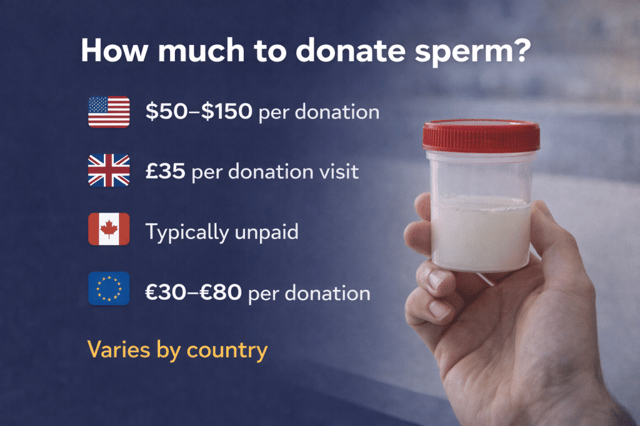
If you are wondering how much to donate sperm in the United Kingdom, the answer is straightforward: UK sperm donors cannot be paid directly for their donations. Instead, donors receive up to £45 per clinic visit as compensation for reasonable expenses such as travel, childcare, and time away from work. This altruistic model, regulated by the Human Fertilisation and Embryology Authority (HFEA), ensures that the motivation for donating sperm remains primarily about helping others — not financial gain.
Understanding how much to donate sperm pays is just one part of the picture. The process involves medical screening, legal considerations, and a commitment of several months. If you are considering becoming a donor, this guide covers everything from compensation details to eligibility requirements, the donation process, and what happens after you donate.
How Much to Donate Sperm: What Do UK Donors Actually Receive?
The question of how much to donate sperm in the UK has a clear regulatory answer. Under the Human Fertilisation and Embryology Act, direct payment for sperm donation is prohibited. What donors receive is expense-based compensation — not a fee for their sperm.
Ready to start your project?
Join +450,000 members who find their co-parent or sperm donor
Start free✓ Free ✓ No commitment ✓ Verified
As of October 2024, HFEA guidelines allow donors to receive up to £45 per clinic visit. This amount is intended to cover documented expenses including travel costs to and from the clinic, childcare if needed during appointments, time taken off work, and any other reasonable out-of-pocket expenses related to the donation.
If a donor’s actual expenses exceed £45 per visit — for example, due to long-distance travel or overnight accommodation — they may claim higher reimbursement with supporting documentation. The key principle is that compensation must reflect actual costs, not provide a profit motive.
For context, if a donor attends the clinic once a week for 10 weeks, total compensation would be approximately £450. This is modest by any standard — and it is why understanding how much to donate sperm pays is important for setting realistic expectations before you commit.
How Does UK Compensation Compare Internationally?
When people ask how much to donate sperm, they often want to know how UK rates compare to other countries. The differences are significant.
In the United States, sperm donors are compensated directly — typically $70 to $200 per donation. Over a six-month commitment, American donors can earn $4,000 to $8,400 or more. In Denmark — home to some of the world’s largest sperm banks — donors receive modest compensation that varies by facility. In Australia and Canada, the model is similar to the UK: altruistic donation with expense reimbursement only.
The UK’s altruistic model means that how much to donate sperm pays here is among the lowest globally. This contributes to the UK’s well-documented donor shortage — over 90% of donor sperm used in the UK is imported from countries where compensation is higher and donor pools are larger. However, the altruistic model reflects UK values around preventing the commercialisation of human reproductive material, consistent with similar rules governing organ and blood donation.
How Much to Donate Sperm: Non-Financial Benefits
While the financial answer to how much to donate sperm is modest, the non-financial benefits are significant. Accepted donors receive comprehensive free health screening including blood and urine tests for infectious diseases (HIV, hepatitis B and C, syphilis, chlamydia, gonorrhoea, CMV), genetic carrier screening for hereditary conditions, a full physical examination, semen analysis evaluating sperm count, motility, and morphology, and ongoing health monitoring with retesting every three months throughout the donation period.
These tests — which would cost hundreds of pounds privately — provide valuable insight into your genetic and reproductive health. For many donors, this free medical information is one of the most practical benefits of the process, regardless of how much to donate sperm pays in monetary terms.
Beyond health screening, the most significant benefit is the knowledge that you helped someone build the family they dreamed of. Thousands of individuals and couples in the UK — single women, same-sex couples, and heterosexual couples facing male infertility — rely on donor sperm to have children. For most donors, this sense of purpose outweighs the financial compensation entirely.
What Are the Requirements to Donate Sperm in the UK?
Understanding how much to donate sperm is important, but so is knowing whether you qualify. The HFEA and individual clinics set specific eligibility criteria.
You must be between 18 and 45 years old (most clinics prefer 18–41). You must be in good general physical and mental health, with no serious medical conditions or sexually transmitted infections. You must have no significant family history of hereditary genetic disorders. You must produce high-quality sperm that survives the freezing and thawing process — since all donated sperm is cryopreserved. You must not be adopted (a traceable family medical history is required). You must consent to identity disclosure — since April 2005, all UK donors must agree that donor-conceived children can access identifying information at age 18. And you must be willing to commit to regular clinic visits over several months.
Acceptance rates at UK sperm banks are extremely low — typically fewer than 5% of applicants make it through the full screening process. This rigorous selection ensures the highest standards of donor quality and safety.
How Does the Donation Process Work?
Knowing how much to donate sperm compensates you is one thing — understanding the time commitment is another. The process follows a structured pathway.
Step 1: Contact a clinic. Reach out to an HFEA-licensed fertility clinic or sperm bank. They will explain the requirements and process, and you will complete initial forms about your health, family history, and motivations.
Step 2: Medical screening. You attend the clinic for a detailed consultation, blood and urine tests, a physical examination, and an initial semen sample for analysis. This phase determines whether your sperm meets quality standards and whether you are free from infectious and genetic conditions.
Step 3: Counselling. Mandatory counselling ensures you understand the psychological, legal, and emotional implications of donation — including the fact that donor-conceived children can contact you at age 18.
Step 4: Consent. You sign written consent forms specifying how your sperm may be used, whether you agree to identity disclosure, and any conditions you wish to place on the donation.
Step 5: Regular donations. Once accepted, you visit the clinic typically once or twice a week for 5 to 10 weeks or longer. At each visit, you provide a semen sample in a private room. Samples are frozen and quarantined for six months. You may need to abstain from ejaculation for 2 to 5 days before each visit to ensure optimal sperm quality.
Step 6: Final testing. Approximately six months after your last donation, you return for a final blood test. This confirms you remain free of infectious diseases before your frozen samples are released for use.
How Much to Donate Sperm: Legal Considerations
Beyond how much to donate sperm compensates financially, understanding the legal framework is essential.
When you donate through an HFEA-licensed clinic, you have no legal parental rights or financial obligations toward any children conceived from your donation. You will not be named on any birth certificate. The intended parents are the legal parents.
However, since April 2005, donor-conceived children have the right to access identifying information about you — including your name and last known address — when they turn 18. At age 16, they can access non-identifying information. You must consent to this before donating.
The HFEA also caps the number of families your sperm can help create at 10 families maximum. You can choose to set a lower personal limit.
If you donate privately — outside a licensed clinic — the legal protections do not apply, and you could be considered the child’s legal father. This is a critical distinction that goes beyond how much to donate sperm pays.
Alternatives: Donating as a Known Donor or Co-Parent
Some men interested in how much to donate sperm ultimately decide that the traditional clinic route is not the right fit. An alternative is to become a known donor or co-parent through platforms like CoParents.co.uk — part of the CoParents network, a co-parenting and sperm donation platform connecting over 150,000 users since 2008.
As a known donor, you can choose your level of involvement — from no contact with the child to an active co-parenting role. The platform provides a structured environment for discussing expectations, values, health screening, and legal arrangements before any commitment is made.
For men who want to help create a family and also play a meaningful role in a child’s life, co-parenting offers something that anonymous clinic-based donation cannot: an ongoing relationship with the child you helped bring into the world.
Frequently Asked Questions

How much to donate sperm does a UK donor actually receive?
UK sperm donors receive up to £45 per clinic visit as expense compensation. Over a typical 10-week donation commitment, total compensation is approximately £450. Higher reimbursement may be available if documented expenses exceed the standard amount. Direct payment for sperm is illegal in the UK.
How often can I donate sperm in the UK?
Most clinics ask donors to attend once or twice per week during the active donation period, which typically lasts 5 to 10 weeks. The exact frequency depends on the clinic’s protocols and your availability. You will need to abstain from ejaculation for 2 to 5 days before each donation visit.
Is there a minimum height requirement for UK sperm donors?
There is no legally mandated minimum height for sperm donors in the UK. Individual clinics may have their own preferences, but height alone is not typically a decisive factor. The primary criteria focus on health, sperm quality, family medical history, and willingness to commit to the process.
How much to donate sperm pays in the US compared to the UK?
US sperm donors typically earn $70 to $200 per donation, with total earnings of $4,000 to $8,400+ over six months. UK donors receive up to £45 per visit in expense reimbursement only. The difference reflects the UK’s altruistic donation model versus the US’s compensation-based system.
Can I donate sperm privately and earn more?
Private sperm donation in the UK does not operate within the HFEA compensation framework. Some private arrangements may involve different financial terms, but they also carry significant legal risks — including the possibility of being considered the child’s legal father. If you are asking how much to donate sperm outside a licensed clinic, the financial question should be secondary to the legal implications. A legal agreement and independent medical screening are essential in any private arrangement.