
If you are exploring donor sperm options, you have more routes to parenthood than you might think. Whether you are a single woman, a same-sex couple, or dealing with male factor infertility, using donor sperm is one of the most effective ways to start a family. In the UK, all donor sperm used in licensed clinics must be screened for infectious diseases, undergo semen analysis, and be quarantined before use — with the HFEA regulating every step of the process. Understanding the different donor sperm options available helps you make informed decisions and choose the path that fits your circumstances.
CoParents.co.uk, a co-parenting and sperm donation platform with over 150,000 members since 2008, connects people with donors and co-parents across the UK — helping make every route to parenthood more accessible.
What Are the Main Donor Sperm Options in the UK?
There are several proven donor sperm options for people trying to conceive in the UK. The right choice depends on your medical situation, relationship status, budget, and personal preferences. Here is a clear breakdown of the most common routes.
Ready to start your project?
Join +450,000 members who find their co-parent or sperm donor
Start free✓ Free ✓ No commitment ✓ Verified
How Does Intrauterine Insemination With Donor Sperm Work?
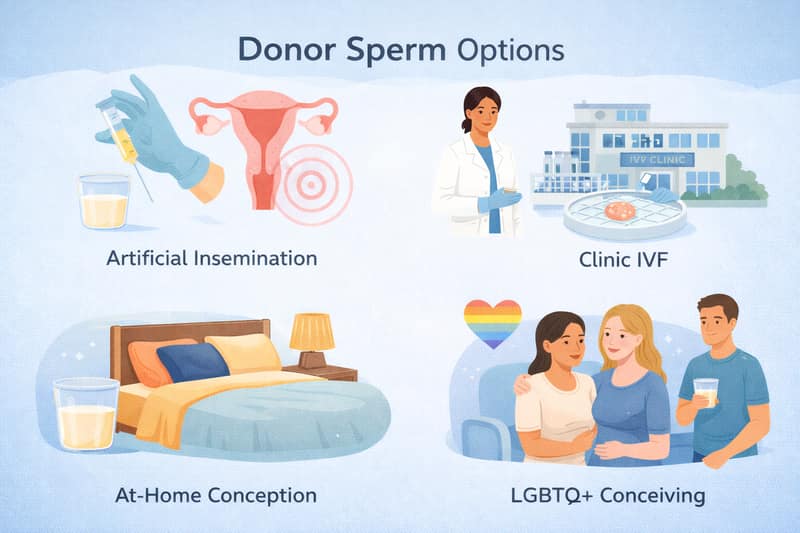
Intrauterine insemination (IUI) is the most straightforward of the clinical donor sperm options. Washed and concentrated donor sperm is placed directly into the uterus using a thin catheter, timed to coincide with ovulation. The procedure takes just a few minutes and is performed at a licensed fertility clinic.
IUI with donor sperm is typically recommended for single women and same-sex couples without known fertility issues, women with unexplained infertility, and cases where the male partner has a very low sperm count or absent sperm.
According to HFEA data, IUI success rates with donor sperm average around 12% to 16% per cycle for women under 35, though this varies by clinic and individual circumstances. Most clinics recommend trying up to six cycles before considering more advanced treatment. The NHS provides guidance on IUI eligibility and funding. IUI is significantly less expensive than IVF, with typical costs ranging from £800 to £1,500 per cycle including the donor sperm.
Is IVF With Donor Sperm an Option?
In vitro fertilisation (IVF) combined with donor sperm is one of the most effective donor sperm options for people who need additional support to conceive. In IVF, eggs are collected from the woman’s ovaries after hormone stimulation, then fertilised with donor sperm in a laboratory. The resulting embryos are transferred to the uterus.
IVF with donor sperm is recommended when IUI has not been successful after several attempts, the woman has blocked or damaged fallopian tubes, endometriosis, or reduced ovarian reserve, or when ICSI (Intracytoplasmic Sperm Injection) is needed because of poor sperm quality.
ICSI involves injecting a single donor sperm directly into an egg. It is used when the sperm sample — whether from a donor or a partner — has low motility or concentration. IVF with donor sperm typically costs £4,000 to £8,000 per cycle in the UK, depending on the clinic and whether ICSI is required. Success rates are higher than IUI, averaging around 30% to 35% per cycle for women under 35.
Can You Use Frozen Donor Sperm?
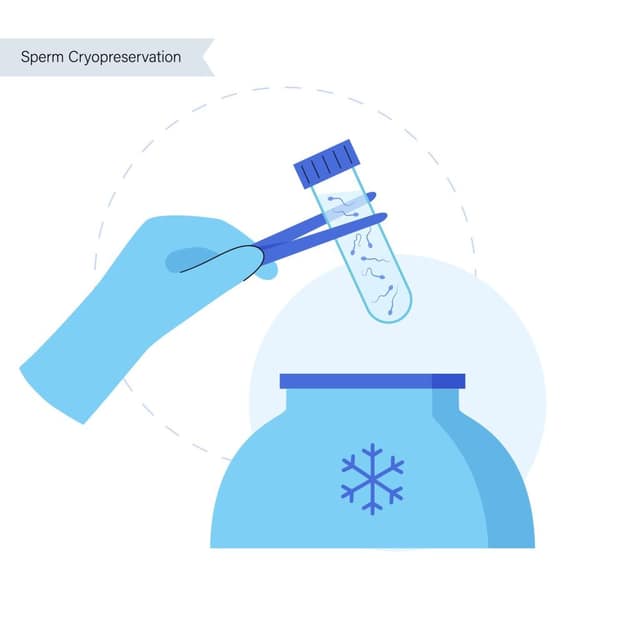
Frozen donor sperm is one of the safest donor sperm options available. In the UK, all donor sperm used at licensed clinics is frozen (cryopreserved) and quarantined for a minimum of six months before being released for treatment. This quarantine period allows the clinic to retest the donor for infectious diseases and ensures the sample is safe.
Frozen donor sperm can be stored for up to 55 years under current UK law, following changes introduced in 2022. It can be used for IUI, IVF, or ICSI — the clinic thaws the sample on the day of your treatment. The HFEA reports that frozen donor sperm produces comparable results to fresh sperm in most clinical settings.
If you are using a known donor, their sperm will still need to be frozen and quarantined at a licensed clinic before it can be used in treatment. This protects both you and any child conceived.
What About Egg Donation Combined With Donor Sperm?
Some people need both donated eggs and donor sperm — a situation sometimes called double donation. This is one of the lesser-known donor sperm options, but it suits single women with diminished ovarian reserve, couples where both partners face fertility challenges, or women over 40 whose egg quality has declined.
In this case, donor eggs are fertilised with donor sperm through IVF, and the resulting embryo is transferred to the recipient’s uterus. Egg donation IVF has high success rates — often above 50% per cycle — because donor eggs typically come from younger women with good ovarian reserve. Costs for double donation IVF range from £8,000 to £15,000 depending on whether the eggs are fresh or frozen and whether they are sourced in the UK or imported.
Is Co-Parenting a Donor Sperm Option?
Co-parenting is an increasingly popular alternative among donor sperm options for people who want to raise a child with a known partner rather than using an anonymous donor. In a co-parenting arrangement, the sperm donor is actively involved in the child’s life as a parent — sharing responsibilities, decisions, and time.
This is fundamentally different from anonymous or clinic-based donation. The donor is not just providing genetic material — they are committing to a long-term parenting role. Co-parenting suits same-sex couples, single parents, and anyone who wants their child to grow up knowing both biological parents.
A co-parenting agreement — though not legally binding in the UK — helps set out expectations around finances, living arrangements, and decision-making before conception. It is strongly recommended to seek legal advice before entering any co-parenting arrangement.
What Are the Legal Implications of Donor Sperm Options?
UK law treats donor sperm differently depending on where conception takes place. If you use donor sperm at an HFEA-licensed clinic, the donor has no legal rights or responsibilities toward the child. The birth mother is always the legal parent, and if she is married or in a civil partnership, her partner automatically becomes the second legal parent.
If you conceive through a private arrangement — such as home insemination with a known donor — the donor may be considered the legal father with all the rights and responsibilities that entails. This is one of the most important reasons to understand all your donor sperm options and the legal framework before proceeding.
Since 2005, donors in the UK are no longer anonymous. Any child conceived through donated sperm at a licensed clinic can access the donor’s identifying information when they turn 18. The HFEA maintains a register of all donors and donor-conceived people. For full details on the legal framework, see the HFEA’s guide to the legal implications of donor sperm.
Frequently Asked Questions
How much does it cost to use donor sperm in the UK?
Costs vary by treatment type. A single vial of donor sperm typically costs £500 to £1,200 from a UK or overseas sperm bank. IUI treatment adds another £800 to £1,500 per cycle, while IVF with donor sperm can cost £4,000 to £8,000 per cycle. Some NHS funding may be available depending on your local Clinical Commissioning Group’s criteria.
Can I choose my sperm donor’s characteristics?
Yes. When using a licensed clinic or sperm bank, you can select a donor based on physical characteristics like height, eye colour, hair colour, and ethnicity. Some banks also provide information about the donor’s education, occupation, hobbies, and a personal message. The level of detail varies between sperm banks.
What are the success rates for donor sperm options?
Success depends on the treatment used and the woman’s age. Among all donor sperm options, IUI with donor sperm has a success rate of around 12% to 16% per cycle for women under 35. IVF with donor sperm averages 30% to 35% per cycle. Egg donation IVF with donor sperm can exceed 50% per cycle. Cumulative rates over multiple cycles are significantly higher.
Is home insemination with donor sperm safe?
Home insemination is legal in the UK but carries risks. The HFEA strongly recommends having treatment at a licensed clinic where the donor’s sperm is screened and tested. If you use unscreened sperm, there is a serious risk of transmitting infections. There are also legal implications — the donor may be considered the legal father if conception happens outside a clinic.
Ready to explore your donor sperm options and take the next step? Sign up free on CoParents.co.uk to connect with donors and co-parents across the UK.