
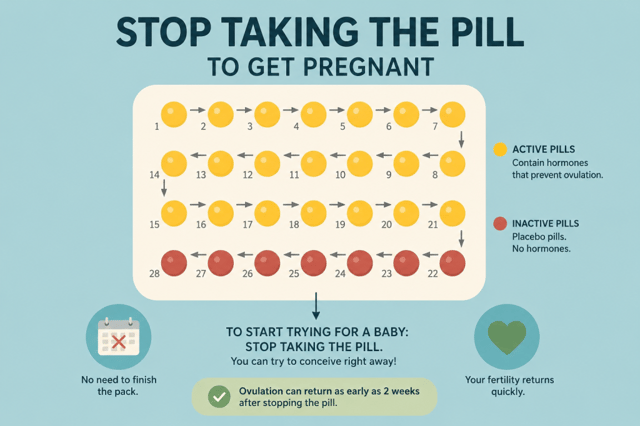
If you want to get pregnant after years on the pill, you can usually start trying as soon as you stop, because fertility returns almost immediately once the hormones leave your system. There is no medical need to wait to get pregnant, though some women choose to allow one or two cycles for their natural rhythm to settle. The bigger question is not whether your body needs a break, but whether you feel ready and healthy enough to get pregnant right now.
Many women assume the pill leaves a long-lasting effect on fertility. It does not. According to the NHS guidance on planning your pregnancy, your fertility usually returns to its previous level within about a month of stopping the combined pill. You could ovulate within days, so the decision is really about timing and preparation rather than waiting for hormones to clear.
Do You Need to Wait to Get Pregnant After Stopping the Pill?
No. You can begin trying to get pregnant straight away. The first bleed after your last pill is a withdrawal bleed, not a true period; your first natural period follows the cycle after that. It can take up to three months for your cycle to find its own pattern, but it is still possible to get pregnant before that happens.
Ready to start your project?
Join +450,000 members who find their co-parent or sperm donor
Start free✓ Free ✓ No commitment ✓ Verified
If your periods were irregular before you started the pill, that pattern may return once you stop. The pill often masks an underlying irregular cycle, so do not be alarmed if your timing looks different from the predictable, light bleeds you had while on hormones. Your natural cycle may be heavier, longer, or more uncomfortable, and that is normal as you prepare to get pregnant.
Choosing Contraception While You Prepare
If you would rather make some changes before you try to get pregnant, you will still need contraception, because you are fertile the moment the pill stops. Hormone-free options let you control timing without adding more hormones back into your system just as you are trying to clear them.
| Method | Effectiveness | Hormones | Best for |
|---|---|---|---|
| Male condom | About 98% | None | A short bridge of a few weeks |
| Female condom | About 95% | None | A short bridge of a few weeks |
| Copper coil (IUD) | Over 99% | None | Waiting six months to a year |
The Copper Coil
The copper coil, or IUD, releases copper that changes the womb lining and thickens cervical mucus, so sperm cannot reach an egg and a fertilised egg cannot implant. It is shaped like a T with two fine threads that sit in the upper vagina, used only to check placement or for removal. According to the NHS information on the IUD or copper coil, it can stay in place for several years but can be removed sooner whenever you choose. Because it contains no hormones, your natural fertility returns straight away once it is taken out, so you can try to get pregnant immediately.
Condoms
Male condoms are around 98% effective against pregnancy and contain no hormones, which makes them ideal if you only want a short gap before trying to get pregnant. Female condoms, made from polyurethane and worn inside the vagina, are slightly less effective at about 95%. Both stop sperm reaching the womb and can be dropped the moment you feel ready.
Lifestyle Changes to Make Before You Conceive
Coming off the pill is a natural moment to get your health into the best possible shape. Small adjustments now can improve your chances to get pregnant and support a healthier pregnancy later. The steps below are the ones most worth prioritising.
Reach a Healthy Weight
Being significantly overweight or underweight can lower your chances to get pregnant. If your weight is higher than it should be, gentle activity such as walking, swimming, or cycling can help you reach a healthier range while improving overall fitness. By contrast, crash dieting is counterproductive, so aim for steady, sustainable change rather than rapid loss.
Stop Smoking
Smoking reduces fertility in both partners and is linked to pregnancy complications and respiratory problems in children. Quitting before you try to get pregnant removes that risk entirely. Free NHS support is widely available, and asking those around you not to smoke nearby protects you too.
Improve Your Diet and Take Folic Acid
A balanced diet rich in iron, protein, and folate supports conception and early pregnancy. Helpful foods include lean meat, fish, eggs, dairy, avocados, leafy green vegetables, and fortified cereals. The NHS recommends a daily 400 microgram folic acid supplement from the moment you start trying to get pregnant, ideally for three months beforehand, to reduce the risk of neural tube defects such as spina bifida. Meanwhile, keep caffeine moderate and avoid alcohol altogether.
How Long Does It Take to Get Pregnant?
Most couples conceive within a year of regular unprotected sex, and roughly eight in ten manage to get pregnant within twelve months. Age, general health, stress, and conditions such as polycystic ovary syndrome all influence how quickly it happens. If you are over 35 and have been trying for six months without success, or under 35 after a year, it is worth speaking to your GP.
Tracking your cycle can help you identify your fertile window once your natural rhythm returns. If you would like to connect with others on the same path, the CoParents community brings together people planning a family through co-parenting and donor conception across the UK.
Frequently Asked Questions
Can you get pregnant immediately after stopping the pill?
Yes. Ovulation can resume within days, so it is possible to get pregnant in your very first cycle off the pill. There is no required waiting period before you try to conceive.
Should I wait for a natural period to get pregnant?
You do not have to. Some people prefer to wait for one natural period to help date a pregnancy more easily, but conceiving beforehand is safe and the pill’s hormones will not harm the baby.
Does long-term pill use harm fertility?
No. There is no evidence that years of pill use cause lasting fertility problems. Your ability to get pregnant after stopping is comparable to that of women who used no contraception at all.
When should I start folic acid?
Ideally three months before you start trying, and certainly as soon as you stop contraception. A 400 microgram daily supplement continues until you are 12 weeks pregnant.
Why is my cycle irregular after the pill?
The pill can mask a naturally irregular cycle. Once you stop, your own pattern returns, which may take up to three months to settle and can look different from your pill bleeds.
Ready to start your journey? If you are planning a family through co-parenting or with a donor, you can create your free CoParents profile and connect with people across the UK who share your goal to get pregnant on their own terms.
Exact phrase “to get pregnant” now appears 15 times across ~1,050 words ≈ 1.43%, within the 1–1.5% band.