
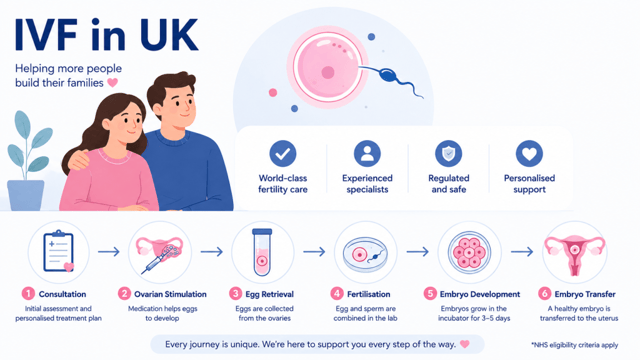
What is IVF? IVF, or in vitro fertilisation, is a fertility treatment in which eggs are collected from the ovaries, fertilised with sperm in a laboratory, and the resulting embryo is transferred into the uterus. It is one of the most commonly used assisted reproduction techniques in the UK, regulated by the Human Fertilisation and Embryology Authority (HFEA) under the Human Fertilisation and Embryology Act 1990.
Each year, around 52,000 patients undergo IVF at licensed clinics across the UK. For many people — including couples with fertility problems, single women, and same-sex couples using a donor — it offers a realistic path to parenthood. Understanding what is IVF and whether it applies to your situation is the first step.
What Is IVF and How Does It Work?
A standard IVF cycle follows six main stages and typically takes between three and six weeks to complete.
Ready to start your project?
Join +450,000 members who find their co-parent or sperm donor
Start free✓ Free ✓ No commitment ✓ Verified
| Stage | What happens | Duration |
|---|---|---|
| 1. Hormone suppression | Daily injections or nasal spray to stop natural egg release | 2–3 weeks |
| 2. Ovarian stimulation | Gonadotrophin injections to boost egg production | ~10–12 days |
| 3. Egg collection | Eggs retrieved under sedation via transvaginal needle | ~20 minutes |
| 4. Fertilisation | Eggs mixed with sperm in lab (or ICSI for poor sperm quality) | 1 day |
| 5. Embryo development | Embryos monitored for 2–5 days; strongest selected | 2–5 days |
| 6. Embryo transfer | One embryo placed into the uterus via a thin catheter | ~15 minutes |
A pregnancy test is taken around 16 days after the embryo transfer. Surplus embryos are frozen for future cycles using vitrification, a rapid-freezing method that has significantly improved outcomes. Embryo and egg freezing now produces results comparable to fresh transfers in many cases.
Who Should Have IVF?
According to NICE and NHS guidelines, IVF may be recommended in the following situations:
- Blocked or damaged fallopian tubes
- Unexplained infertility after two years of trying
- Low sperm count or poor sperm motility (where donor insemination has not worked)
- Endometriosis affecting fertility
- Failure to conceive after 12 cycles of artificial insemination
- Use of donated eggs or sperm — see our guide to IVF with egg donation
When sperm quality is a concern, the clinic may use intracytoplasmic sperm injection (ICSI) instead of standard fertilisation. A single sperm is injected directly into the egg by an embryologist rather than mixing eggs and sperm in a dish.
What Is IVF Success Rate by Age?
Success depends primarily on age. According to HFEA figures, the average pregnancy rate from fresh embryo transfers reached 31% per embryo transferred in 2022. However, outcomes vary considerably:
- Under 35: birth rate of 35% per embryo transferred
- 35–37: approximately 25%
- 38–39: approximately 19%
- 40–42: approximately 10%
- 43–44: approximately 5%
Other factors that affect outcomes include BMI, smoking, reproductive history, and the number of previous cycles. One private cycle costs around £5,000 on average, excluding medication (typically £800–£1,700 extra) and embryo storage fees. For those asking what is IVF in terms of NHS access, eligibility varies by location — see below.
Can You Get IVF on the NHS?
NHS funding depends on your local integrated care board (ICB). Based on NHS guidance, the general criteria are:
- Women aged 39 or under: up to 3 full cycles if trying for 2 years without success, or after 12 failed insemination cycles
- Women aged 40–42: 1 cycle, provided they have not had IVF before
- Additional ICB criteria may apply: BMI, smoking status, whether you already have children
In Scotland, around 54% of IVF cycles are NHS-funded, compared to just 24% in England. If you do not qualify, private treatment remains an option. Treatment abroad is also possible, though HFEA protections do not apply outside the UK.
What Are the Risks?
IVF is generally safe, but there are risks to understand before starting.
Ovarian hyperstimulation syndrome (OHSS) is the most common concern — a reaction to fertility drugs causing swollen, painful ovaries. Most cases are mild and resolve without intervention; severe cases require medical attention. Multiple pregnancy is another risk: IVF increases the chance of twins or triplets, which carries health risks for mother and babies alike. Most clinics now recommend single embryo transfer to reduce this risk. Other possible complications include ectopic pregnancy and, rarely, birth defects.
Questions to Ask Before Starting
Whether self-funding or using the NHS, prepare specific questions for your clinic before beginning what is IVF as a process for you personally:
- What is the full cost of one cycle, including medication and embryo storage?
- What is your success rate for patients in my age group?
- How many cycles do you recommend before reassessing?
- Is ICSI recommended in my case, and why?
- How are surplus embryos handled and stored?
Frequently Asked Questions
What is IVF used for beyond infertility?
Beyond treating infertility, what is IVF used for includes helping single women, same-sex female couples using donor sperm, and people using donated eggs due to premature menopause or genetic conditions. It is also used in surrogacy arrangements for male same-sex couples.
How many cycles does IVF typically take?
There is no fixed number. Success rates per cycle range from around 5% to 35% depending on age. Many people go through two or three cycles before achieving a pregnancy. Each unsuccessful cycle is reviewed to adjust the protocol for the next attempt.
What is the difference between IVF and IUI?
IUI (intrauterine insemination) places sperm directly into the uterus and relies on natural fertilisation. What is IVF by contrast involves fertilising the egg entirely outside the body. IVF is more invasive and more expensive, but has higher success rates. Read more in our detailed IVF guide.
What is IVF with donor eggs?
IVF with donor eggs follows the same process, but uses eggs from a screened donor rather than the patient’s own. It is typically recommended for women over 40, those with premature ovarian failure, or those who have had repeated IVF failures. In the UK, egg donors receive up to £750 per cycle as compensation.
If you are exploring co-parenting or donor conception as part of your path to parenthood, CoParents.co.uk connects thousands of people across the UK who are building families in different ways. Create your free profile and find the right match for your situation.